GTM Coaching  •  Group Engagements  •  B2B SaaS

Your AEs and SEs are not the problem.

They lack a shared system.

Most revenue teams train in silos and wonder why execution stays inconsistent.

I work with CROs and revenue leaders to build a shared operating model - applied to live deals, across every function that touches the buyer.

At a glance
6-8
Weeks per initial engagement

Not a one-day event. A sustained system applied to your live pipeline.

70%
Application and discussion in every session

Frameworks immediately applied to real-world situations, not hypothetical exercises.

4
Functions coached together

AEs, SEs, CS, and Services. One shared operating model.

Client story

What changes when the whole GTM team learns together.

Precursive

Professional Services Automation  •  UK & United States

4
Functions
8
Week program
5★
CEO rating

The Challenge

Jonathan Corrie, CEO of Precursive, needed his GTM organisation to be tightly aligned across Sales, Customer Success, and Services. The problem was threefold: inconsistent customer engagement across functions, varied ability to communicate business value to multiple stakeholder types, and limited commercial awareness within the Services team despite their direct customer contact.

“I wanted some consistency in those teams regarding customer engagement, discovery, how we communicate the value of our solutions to our customers and the individual stakeholders within those companies.”

What Changed

Sales & Presales: The Value Discovery Map gave the presales team a structured approach to multi-stakeholder discovery. AEs learned to look horizontally and vertically across buyer organisations rather than remaining single-threaded.

Services & CS: The most significant shift was moving from product knowledge-led demonstrations to value-led conversations anchored in business outcomes relevant to the specific audience.

Observable change: “Everyone is much more in tune to: how do we talk about value? How do we communicate value? How do we diagnose value? That’s genuinely noticeable. Raising the altitude of how people think.”

Business impact: “We’re on for a very strong year, and this will definitely be a part of the foundation.”

“Working with you has been an absolute pleasure. You’ve been so professional, always prepared for every meeting. You demonstrate immediately that I’ve made a good decision on partnering. You showed up, you were prepared, you knew my business. Probably the best virtual training I’ve attended. Five stars. Highly recommend.”
Jonathan CorrieCEO, Precursive
From the room

Client testimonials

On commercial impact

Nikhil is an outstanding sales coach who has a real talent for making concepts practical and immediately applicable. He ran a multi-week program for our pre- and post-sales teams covering value discovery and demo techniques, and the impact on how we approach customer conversations has been clear.

Tommy ThorntonHead of Sales, USA - Precursive
On the cross-functional model

Nikhil Sarma delivered a high-quality coaching program that directly supported our sales priorities. The content was relevant, actionable, and aligned with our internal processes and deal cycle, making it easy for AEs and SEs to apply to live opportunities. Feedback from the team was consistently positive, and we saw noticeable improvements in the desired behaviours and skills, as well as some early business wins.

Joanna SakalianField Sales Enablement Lead - Storyblok
On behavior change

[Nikhil] went above and beyond to help us perfect our demo. Nikhil not only guided me through the technical aspects of demoing our platform but also provided valuable insights on qualifying opportunities effectively. His expertise, patience, and clear communication made the process smooth and highly productive. I would highly recommend Nikhil to anyone looking for someone who can elevate both their product presentations and sales readiness.

Ed PriscoDirector, Sales - Locus
Why last year's training didn't work

Your team never had a chance to apply it.

The Ebbinghaus Forgetting Curve is real.

Nearly 70% of new information is forgotten within 24 hours, increasing to 90% in 7 days. The pace of change in tech sales makes this worse, not better.

This is not the only problem. One-off trainings fail before the forgetting even begins. Here's what's actually happening.

Trained in silos.

AEs attend one program. SEs attend another. CS is left out entirely. The result is a team that speaks three different languages in front of the same buyer - and a buyer who notices the inconsistency.

Applied to hypotheticals.

Role plays and case studies feel relevant in a room. They degrade within weeks because they were never practised on real deals. Behavior change needs real stakes, not simulated ones.

No reinforcement loop.

A 2-day workshop produces awareness and tips, not habit. Without weekly reinforcement applied to live opportunities, skills revert within a quarter.

The deeper risk

You've been training for FOMO.
But enterprise buying teams are driven by FOMU - Fear of Messing Up.

Enterprise buying committees stall because they're afraid of messing up - a failed implementation, an executive who wasn't aligned, a vendor who oversold. Vendor teams that close consistently are the ones who know how to de-risk the decision for the buyer.

A different approach

Most programs train individuals.
This one builds a team.

The difference is structural. Here is what changes when you move from generic enablement to a purpose-built engagement.

 Typical enablementThis engagement
Who is in the roomKey DifferentiatorOne function at a timeAEs, SEs (and CS & PS) together
What they work onHypothetical scenariosYour live pipeline, every session
Duration1-2 day events6-8 weeks sustained cadence
Framework orientationSeller-first: how to pitchBuyer-first: how to build decision confidence
ReinforcementKey DifferentiatorNone - skills decay within weeksWeekly coaching applied to real deals
Leader involvementLeaders send the team, wait for resultsFirst-line managers part of the engagement
Discovery depthKey DifferentiatorGeneric questioning frameworksMulti-stakeholder value mapping across C-level, management, and operational layers

The framework behind this approach was built across 15+ years of frontline GTM work - carrying quota, leading presales, and coaching teams across EMEA and APAC.

The methodology

Built around the buyer's decision problem.

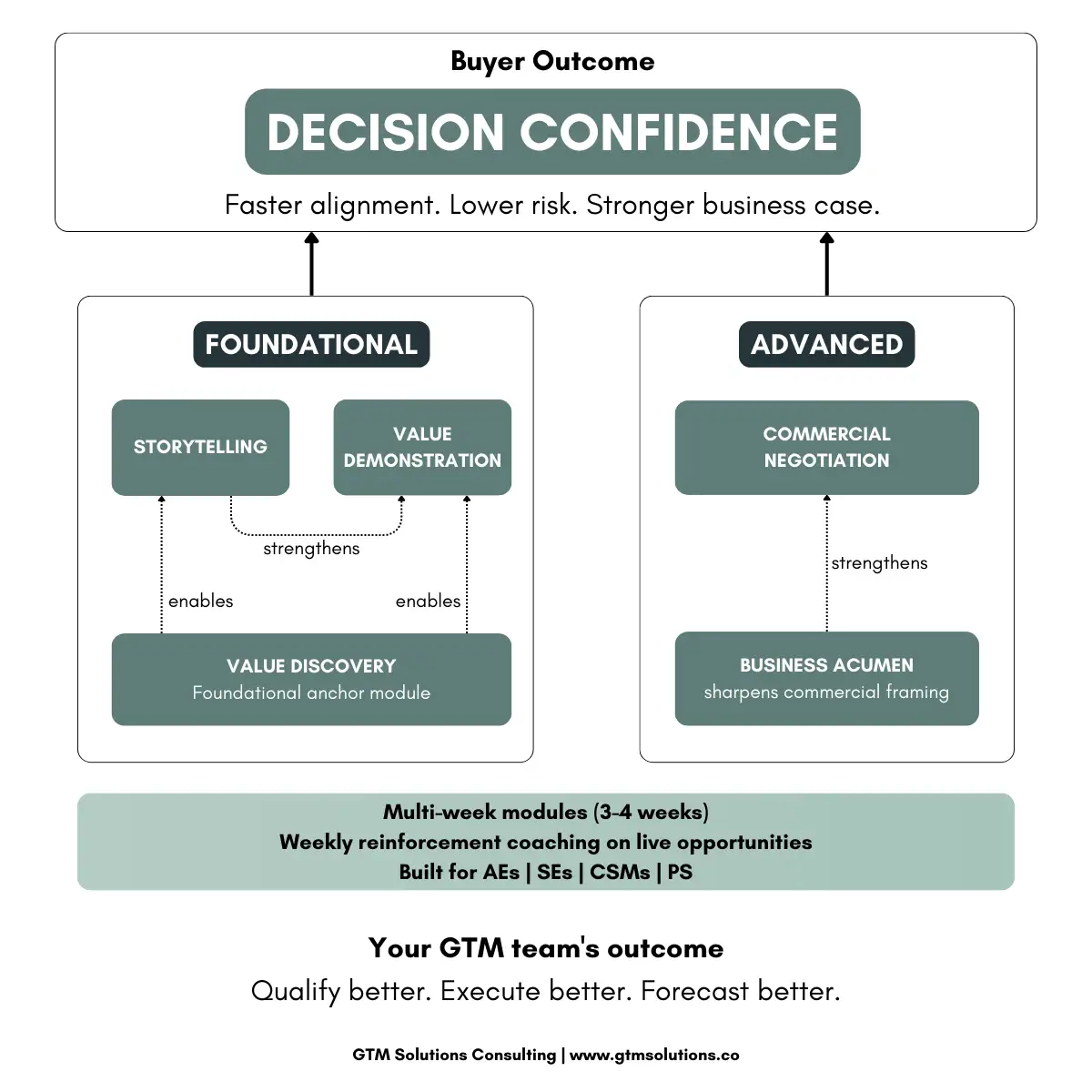
The Decision Confidence Operating System is structured in two tracks - Foundational and Advanced.

Value Discovery anchors everything because you cannot build alignment around a problem you haven't diagnosed.

Convergence of C-level interests

Buyers don't stall because they don't see value. They stall because key stakeholders see different value - and no one has mapped how those interests converge. Teaching your team to identify alignment across the executive layer is the single highest-leverage discovery skill in enterprise sales.

Internal political risk

Every enterprise deal has a political dimension. The buyer champion who loves your solution also has a boss who cares more about not looking foolish than about ROI. Your team needs to understand and help navigate that internal risk - not ignore it and hope the business case is enough.

Cross-functional, applied to live pipeline

AEs, SEs, CS, and Services - in the same room, with the same framework, working on the same active deals. The shared language this creates is more valuable than any individual skill improvement.

Weekly reinforcement, not periodic events

The engagement runs 6-8 weeks with a consistent cadence. Skills are practised under real commercial pressure repeatedly - which is the only way behavior actually changes.

The Decision Confidence Operating System

Value Discovery is the foundation. Everything builds from it.

A structured framework applied to your live pipeline across foundational and advanced tracks - from discovery and business case construction through to executive storytelling, demo structure, and commercial negotiation.

The Decision Confidence Operating System framework diagram showing foundational and advanced coaching tracks
How I work

Principles that shape every engagement.

Before you commit to an engagement, you should know exactly how I work and why. These are not aspirations - they are structural commitments built into the way every engagement is designed and delivered.

I start with your business, not my curriculum.

Before the first session, I map your team structure, deal environment, buyer personas, and competitive dynamics. What you get is not a standard program with your logo on it - it is a coaching engagement built around the specific gaps that are costing you pipeline.

More than 70% of every session is application.

Frameworks are introduced, then immediately applied to your live deals. Theory without practice degrades within weeks. When your team works on real opportunities under real pressure, the learning sticks - and the deals benefit directly.

AEs and SEs are coached together, by design.

The handoff between sales and presales is where deals are won or lost. Coaching these functions separately perpetuates the misalignment. A shared framework, developed in the same room, builds the operating model your buyers experience as coherent.

Everything points toward the buyer's decision.

This is not a program about better pitching. Every session is oriented around one question: what does this buyer need in order to decide confidently? That shift - from seller-first to buyer-first instinct - is the durable outcome.

You are part of the engagement, not a passenger.

CROs and VPs who stay at arm's length get incremental results. The leaders who see meaningful forecast improvement are the ones who engage with the deal-level work alongside their teams. Your visibility into deal quality is what makes the change durable.

I work with a limited number of clients at any time.

That constraint is deliberate. The quality of preparation, the deal-level attention, and the reinforcement cadence I deliver are only possible when the number of active engagements is small. Depth over volume is not a marketing line - it is a structural commitment.
Outcomes by function

What changes for each part of your team.

A shared operating model does not mean identical training. Each function leaves with outcomes specific to their role - and a shared language that makes the whole motion more coherent.

Sales

Higher quality pipeline. Fewer no-decisions.

AEs leave with a structured discovery discipline that builds multi-stakeholder business cases from the inside out. Deals that previously stalled move. Forecasts become more reliable.

Solutions Engineering

SEs who shape deals, not just support them.

Presales teams leave with the commercial language and demo structure to drive decisions, not just demonstrate features. Discovery-led demos that speak to economic buyers - not features to technical evaluators.

Customer Success

Renewals grounded in demonstrated value.

CS teams leave with the ability to quantify and communicate the outcomes their customers have achieved - and use that evidence to drive expansion and protect retention against procurement pressure.

Professional Services

Delivery teams that speak the language of business.

Services teams leave with commercial awareness and value communication skills that elevate every customer interaction - from onboarding through delivery reviews and escalations.

What to expect

What a coaching engagement actually feels like.

From a CRO or VP perspective - the mindset behind the work, and the process that delivers it.

Your team will be challenged.

This is not a comfortable affirmation of existing habits. Your team will be pushed to examine how they currently discover, demonstrate, and defend value - and to do it differently. Leaders are part of that conversation, not observers.

The buyer's decision is the anchor.

Every session is oriented around your buyers' reality - their priorities, their stakeholders, their internal constraints. The methodology is built around helping buyers decide, not helping sellers pitch.

Live deals are the curriculum.

Frameworks are not taught in isolation. Every session uses your actual pipeline as raw material. The Value Discovery Map and Compass Questioning Model are practised under real commercial pressure, not hypothetical exercises.

The engagement process

Discovery

A structured conversation with you - and where relevant, your team leads - to understand your deal environment, pipeline composition, buyer profiles, and the specific behaviors you need to change. This is not a sales call. It is the first session of the engagement.

Scoping

Based on discovery, I define the engagement structure: which functions are included, session cadence, focus areas per track, and how live deals will be integrated. You receive a written scope before anything starts.

Kick-off

The engagement opens with a full-team session that establishes the framework, sets the operating model for how sessions will run, and begins applying the Value Discovery Map to your current pipeline. The first session produces real output.

Weekly cadence and reinforcement coaching

Sessions run weekly across the engagement window. Each one revisits live deals, reinforces the prior week's framework application, and introduces the next layer of the Decision Confidence Operating System. You receive a written summary after each session.

Optional: extended reinforcement

For teams that want to embed the operating model more deeply, an extended reinforcement track continues beyond the initial engagement - lighter cadence, focused on consolidating behavioral change and coaching your internal champions to sustain it.

Our first step starts here

If this resonates, let's talk.

If what you've read reflects the reality your team is struggling with, schedule a leadership conversation.

We will talk about where your team is, where you want them to be, and whether my approach will help you get there.

I work with a limited number of clients at any time to ensure depth over volume.