
01. The misdiagnosis
Every CRO I have worked with this year has opened the same way. Win rates are slipping. Deal cycles are stretching. The forecast is becoming unreliable. And every CRO has the same first instinct — reach for the obvious lever. More pipeline. Better demos. Tighter qualification. Sharper messaging.
These levers are not wrong. They are insufficient. They treat the symptom of a deal that did not close as if it lived inside the seller. It almost never does.
We were not losing because our team got worse. We were losing because the buying committee got bigger, and our motion had not changed shape to meet it.
What has shifted in the last two years is not the discipline of selling. It is the difficulty of buying. Committees have widened. Approval thresholds have risen. The cost of being wrong — for the buyer — has gone up. And the practices we built when buying was a simpler activity do not survive contact with that new reality.
02. What buyers are actually doing
When I sit down with a buying committee post-deal, win or lose, the picture is consistent. The committee is not evaluating your product. It is making a business decision under risk. The product is one input. The cost of getting it wrong, internally, is the dominant input.
This changes what they need from you. They need to be able to:
- Justify the decision to people who were not in the room with you.
- Defend the decision to people whose budgets you are competing against.
- Operate the decision once procurement and finance have moved on.
Most sales motions are built to do the first of these well, attempt the second, and leave the third entirely to chance. That is the gap. Not skill, not headcount. The motion itself.
03. Three signals the motion has stopped working
You do not need a benchmark report to know this is happening to your team. You need three signals, and you will already recognise them.
1. Deals are dying at consensus, not at evaluation.
Your AEs are getting champions. You are getting demos. You are even getting verbal commitments. And the deals are slipping out the back of the quarter not because someone said no — but because the committee could not agree on a yes.
2. Forecast confidence is decoupling from activity.
Activity metrics look healthy. Win rates do not. You are not facing a discipline problem. You are facing a problem where the things you can measure are no longer correlated with the outcomes you need.
3. SEs and AEs are telling different stories about the same deal.
Walk through a Mutual Action Plan with three people who touched the same deal and you will hear three deals. That inconsistency is the cost of training in silos, not the cost of any one person's effort.
04. What a buyer-centric motion looks like
The fix is structural. It is not a quota of new training hours. It is a shift in what your motion is organised around. Three commitments do most of the work.
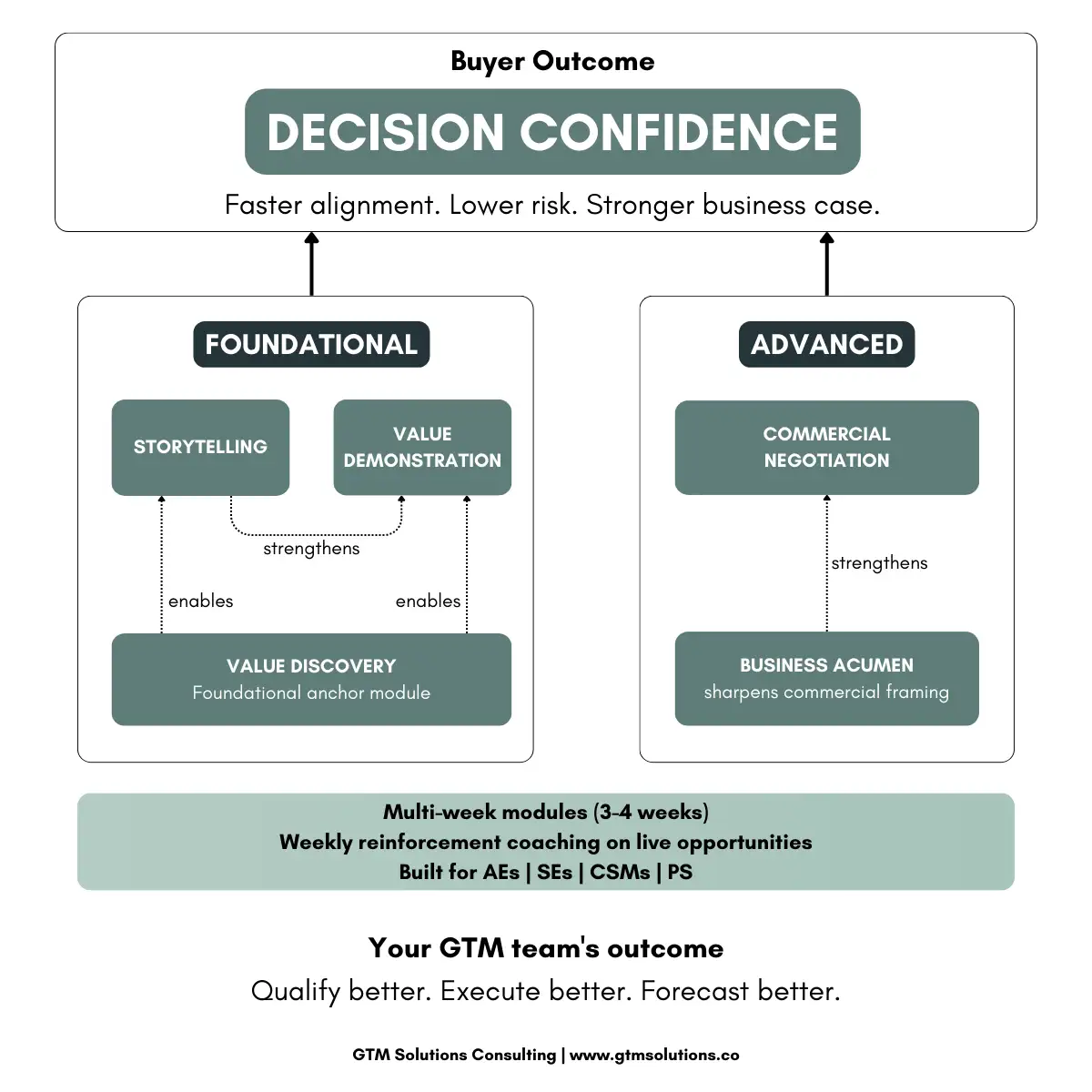
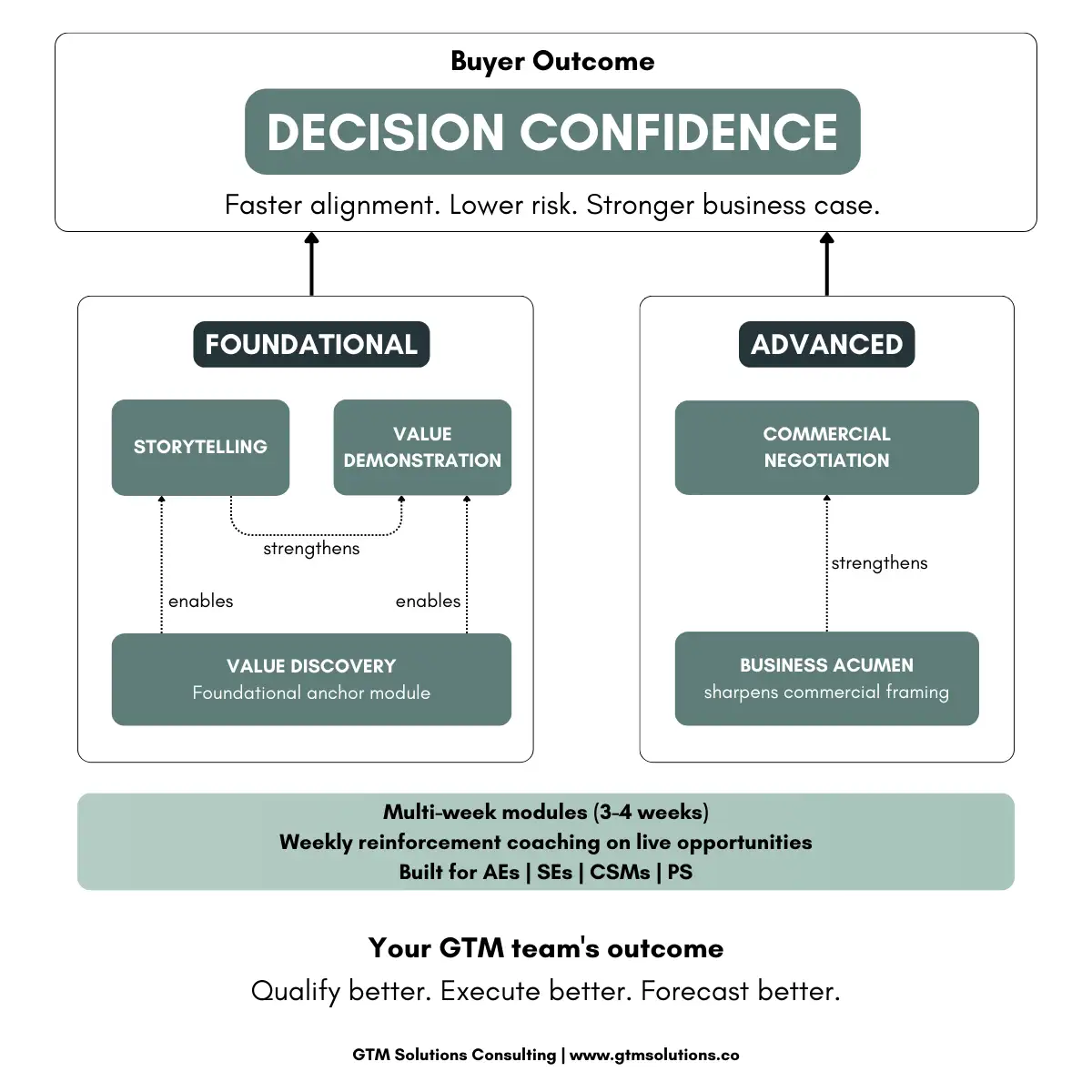
Discovery covers the funder, the runner, and the user. Not at the end, when you are confirming. At the start, when you are scoping. This is what the Value Discovery Map exists to enforce — coverage across the C-level, managerial, and operational tiers of the buying committee, before a demo is built.
Storytelling builds a case that travels without you. Your champion has to be able to defend the decision in a room you are not in. Your motion either produces them an artefact that does that — or it does not.
Negotiation is the last 10% of a value conversation, not a separate stage. The terms you can hold come from the value you have already established. If procurement is the first time you talk price, you have already lost most of your leverage.
05. Where to start this quarter
You do not need to rebuild the motion to find out if it is the problem. Pull three lost deals from last quarter, ideally ones that ended in no decision rather than a competitive loss. Walk the committee map. Find the tier you did not cover.
If the answer is the same across all three deals — and in my engagements, it almost always is — then you have your diagnosis. And the rest of this work has a place to start.